

 English
 Deutsch
 русский
Industry News
Is Trampoline Good for Osteoporosis? What You Need to Know
Content
- 1 How Bone Density Works — and Why Impact Matters
- 2 What the Research Says About Trampolining and Bone Health
- 3 Trampoline vs. Other Bone-Building Exercises: A Comparison
- 4 Who Can Benefit — and Who Should Be Careful
- 5 How to Rebound Safely with Osteoporosis
- 6 Choosing the Right Trampoline for Bone Health Exercise
- 7 Additional Benefits of Rebounding That Support Osteoporosis Management
- 8 A Realistic Expectation: What Trampolining Can and Cannot Do
Bone density loss is a slow and often silent process — and by the time many people receive an osteoporosis diagnosis, they're already searching for safe, effective ways to slow it down or reverse it. As trampoline manufacturers, we hear this question regularly from distributors, fitness retailers, and end users alike: is trampoline exercise actually good for osteoporosis? The short answer is yes, with important nuances. Let's walk through the science, the risks, and how to make it work safely.
How Bone Density Works — and Why Impact Matters
Bone is living tissue. It responds to mechanical stress by rebuilding itself stronger — a process called bone remodeling. When bones experience repeated loading forces, osteoblasts (bone-forming cells) are stimulated to produce new bone matrix. This is why weight-bearing and impact exercise is consistently recommended for people at risk of or living with osteoporosis.
According to the National Osteoporosis Foundation, activities that place stress on bones — such as walking, dancing, hiking, and rebounding — are among the most effective non-pharmacological strategies for maintaining or improving bone mineral density (BMD). The key is finding the right level of impact: enough to stimulate bone growth, but not so much that it risks fracture.
Trampolining, specifically mini trampoline rebounding, sits in an interesting middle ground. It delivers gravitational loading up to 3–4 times body weight at peak bounce, yet the elastic surface absorbs a significant portion of the landing shock — reducing joint stress compared to running or jumping on hard ground.
What the Research Says About Trampolining and Bone Health
Several studies have examined rebounding exercise and its effect on bone density, particularly in postmenopausal women — the population most vulnerable to osteoporosis.
- A study published in the Journal of Musculoskeletal and Neuronal Interactions found that jump training significantly increased bone mineral density in the lumbar spine and femoral neck compared to non-impact exercise.
- Research from Osteoporosis International highlighted that even low-intensity vertical loading — such as gentle rebounding — produced measurable improvements in hip BMD over a 12-month period in older women.
- A NASA study famously noted that rebounding is 68% more efficient than jogging at stimulating the musculoskeletal system, while producing less landing impact on bones and joints.
These findings consistently point to mini trampoline rebounding as a promising, low-risk method to support bone health — provided it is done correctly and with the appropriate equipment.
Trampoline vs. Other Bone-Building Exercises: A Comparison
It helps to see how rebounding stacks up against other commonly recommended activities for osteoporosis management:
| Exercise Type | Bone-Loading Effect | Joint Stress | Fall/Fracture Risk | Suitable for Osteoporosis? |
|---|---|---|---|---|
| Mini Trampoline Rebounding | High | Low–Medium | Low (with handrail) | Yes (moderate stage) |
| Walking | Moderate | Low | Low–Medium | Yes |
| Running / Jogging | High | High | Medium | Caution needed |
| Swimming | Low | Very Low | Very Low | Limited bone benefit |
| Large Outdoor Trampoline | Very High | Medium | Higher | Not recommended |
The table makes clear that mini trampolines offer a unique combination of strong bone stimulation with reduced joint impact — a balance that few other activities can match.
Who Can Benefit — and Who Should Be Careful
Not everyone with osteoporosis is in the same situation. The appropriateness of trampoline exercise depends heavily on the stage and severity of bone loss.
Good Candidates for Trampoline Rebounding
- People with osteopenia (low bone density, but not yet full osteoporosis) — rebounding can be highly effective for slowing further loss.
- Individuals with mild to moderate osteoporosis who have been cleared by their physician for weight-bearing exercise.
- Postmenopausal women and older adults looking for a low-impact routine they can maintain consistently.
- Those recovering from sedentary periods who need a gentle re-entry into physical activity.
Those Who Should Avoid or Consult a Doctor First
- People with severe osteoporosis or a recent vertebral or hip fracture — jumping of any kind could pose fracture risk.
- Those with significant balance problems or neurological conditions that affect coordination.
- Anyone whose physician has specifically restricted high-impact or weight-bearing activity.
The bottom line: always consult a healthcare provider before beginning any new exercise regimen when osteoporosis is involved. The exercise itself is not the variable — suitability depends on the individual's bone health status.
How to Rebound Safely with Osteoporosis
Assuming a person is medically cleared, the way they use a trampoline matters enormously. Here are the practical guidelines we recommend based on what the research and physical therapy community consistently advises:
Start with Low-Impact Movements
There is no need to leave the mat surface at all in the beginning. Simply shifting weight from foot to foot or performing gentle marching in place on the trampoline mat is enough to create gravitational loading on the bones. Start with 5–10 minutes per session, 3 times per week.
Use a Stability Handrail
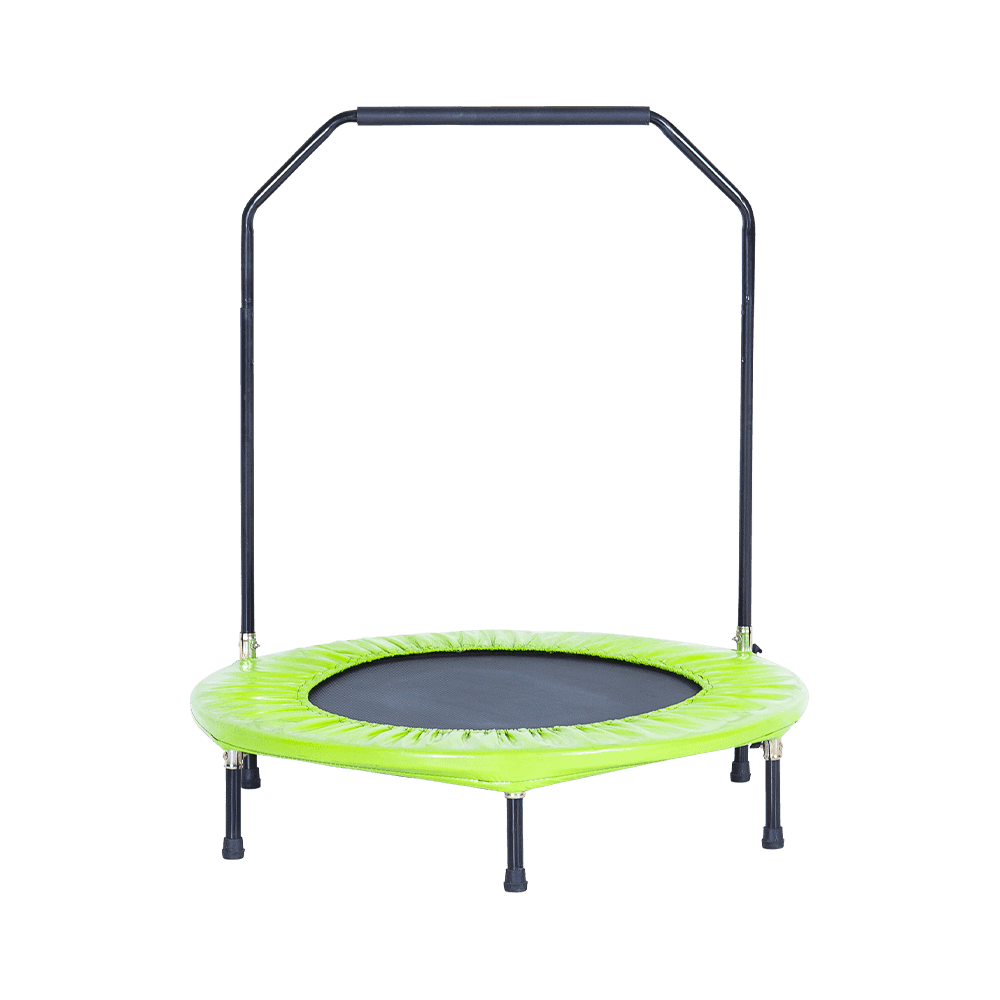
For people with osteoporosis, a fall is far more dangerous than for the average user. A sturdy handlebar or stability bar attached to the mini trampoline is not optional — it is essential. It allows the user to focus on movement without fear of losing balance, and research shows that fear of falling itself reduces physical activity in older adults, creating a damaging cycle.
Progress Gradually
After a few weeks of gentle weight-shifting, progress to small bounces where the heels just lift off the mat. Over months, this can build toward a full low-bounce routine. The goal is consistency over intensity — 3 to 5 sessions of 20 minutes per week is widely cited as sufficient for meaningful bone adaptation.
Avoid Spinal Flexion and Twisting
People with osteoporosis — especially in the spine — should avoid movements that cause the torso to bend forward forcefully or twist sharply. Maintain an upright posture throughout rebounding. This protects the vertebral bodies, which are among the most common fracture sites in osteoporosis patients.
Choosing the Right Trampoline for Bone Health Exercise
Not all trampolines are appropriate for osteoporosis-related exercise. Large backyard trampolines introduce too much risk — higher bounce heights, less control, and greater fall potential. The right choice for a bone health routine is a mini trampoline (rebounder), specifically designed for indoor, low-impact fitness use.
When selecting a rebounder for this purpose, prioritize these features:
- A stability handlebar — non-negotiable for users with osteoporosis or balance concerns.
- Strong, stable frame construction — the unit should not wobble or flex when in use.
- Appropriate weight capacity — ensure the product is rated well above the user's body weight for structural safety.
- A mat with controlled spring tension — too loose increases bounce unpredictability; too tight reduces the shock-absorbing benefit.
- Non-slip feet — the base of the unit must grip the floor surface securely during use.
As a trampoline manufacturer, we design our products with these safety and functional standards in mind. If you're looking for a reliable supplier for mini trampolines suitable for adult fitness use, you can explore our mini trampoline product range for available options.
Additional Benefits of Rebounding That Support Osteoporosis Management
Bone density is just one piece of the osteoporosis puzzle. Falling is the other. In fact, over 90% of hip fractures in older adults result from a fall, according to the Centers for Disease Control and Prevention. This means that improving balance and muscle strength is just as important as protecting bone density.
Trampoline rebounding delivers on both fronts:
- Improved proprioception: The slightly unstable surface forces the body to constantly make small balance adjustments, training the proprioceptive system that prevents falls in daily life.
- Increased lower-body muscle mass: Rebounding engages the quadriceps, hamstrings, calves, and glutes — the muscle groups that stabilize the hip and knee joints most vulnerable in osteoporosis patients.
- Lymphatic stimulation: The rhythmic up-and-down motion promotes lymphatic circulation, which supports immune function and may reduce systemic inflammation — a contributing factor in accelerated bone loss.
- Cardiovascular conditioning: Regular aerobic activity supports hormonal health, which in turn affects how well the body absorbs calcium and regulates bone turnover.
A Realistic Expectation: What Trampolining Can and Cannot Do
We want to be direct with our customers and their end users: trampoline rebounding is a supportive tool, not a cure. Osteoporosis is a medical condition that typically requires a comprehensive management approach including nutrition (adequate calcium and vitamin D), medical treatment where appropriate, and multiple forms of exercise.
What consistent rebounding can realistically achieve over 6–12 months:
- A measurable improvement or stabilization in BMD at key sites (hip, lumbar spine) in people who were previously sedentary.
- Meaningful improvements in balance scores and reduced fall frequency.
- Increased lower-body muscle strength and functional mobility.
- Improved quality of life, mood, and confidence in physical activity — which is itself a predictor of long-term adherence.
These are outcomes worth pursuing — and they are well within reach when the right equipment, the right technique, and medical guidance are combined.
 Previous
Product Consultation
Search
Categories
Recent Posts
If you have any questions, please fill out the contact form at the bottom of the page and contact us.
Related products

Anhui Qidi Fitness Equipment Co., Ltd.
Quick Links
Contact Details
Tel: 0086-563-4676999
Fax: 0086-563-4676999
Mobile:086-15158243539
Email: [email protected]
Address: Dongpo Industrial Area, Zhongxi Town, Ningguo City, Anhui Province China
Come and Contact Us
You are welcome to contact us at any time, we value your feedback and suggestions.
