
 English
 Deutsch
 русский
Industry News
Home / Blogs / Industry News / Galvanized Steel Trampoline: Frame Specs, Rust Resistance and Buying Advice
Content
Rust, not torn mats or tired springs, is what usually ends a backyard trampoline's life. The frame is the one component you cannot sensibly replace piece by piece, and once corrosion eats through a leg joint or a welded T-socket, the whole structure is compromised. This is why the phrase galvanized steel trampoline carries technical weight rather than marketing weight: a zinc-protected frame is the difference between a trampoline that lasts three summers and one that lasts ten or more.
The conclusion up front: for any trampoline that lives outdoors, the frame should be galvanized steel — hot-dip galvanized where the budget allows, and pre-galvanized tube with properly treated welds and ends as the economical baseline. Wall thickness, weld quality and how the coating handles cut ends matter more than the word galvanized itself. Painted plain steel looks identical in product photos and fails first at the joints, while aluminum resists corrosion but gives up joint strength. The sections below explain what each option delivers in practice, which numbers to verify, and how to maintain the coating once the trampoline is standing in the yard.
Galvanizing means coating steel in zinc. On a well-built trampoline frame, the fabricated tubes are dipped into a bath of molten zinc at roughly 450 degrees Celsius. The zinc does not simply sit on the surface; it forms bonded zinc-iron alloy layers beneath a pure zinc outer skin, with total coating thickness commonly in the range of 50 to 100 microns. That bond matters, because a frame gets scratched during assembly, dragged across lawns, and knocked by mowers, sleds and everything else a yard throws at it.
The second property is sacrificial protection. Zinc corrodes in preference to steel, so if a scratch exposes bare metal, the surrounding zinc continues to protect that spot electrochemically. Paint cannot do this. A painted coating is a barrier only, and once breached, rust spreads underneath it until the paint blisters and peels away in sheets.
Failure on real frames follows a predictable pattern. Corrosion appears first at weld seams, at cut tube ends, and wherever hardware bites through the coating. Cheaper frames are often rolled from pre-galvanized coil, which means the zinc was applied before the tube was formed and welded; the seam and every saw cut stay bare unless the manufacturer re-treats them. That detail separates a frame that stays clean from one that weeps orange streaks down its legs by the second season.
Put the common frame options side by side and the trade-offs become much easier to see.
| Frame material | How it resists corrosion | Typical outdoor lifespan | Relative cost | Best suited for |
|---|---|---|---|---|
| Hot-dip galvanized steel | Zinc bonded after fabrication, covering welds and cut ends; sacrificial protection at scratches | 8 to 15 years | Moderate | Full-size outdoor round, rectangle and polygon frames |
| Pre-galvanized steel | Zinc applied to the coil before tube forming; welds and cut ends stay exposed unless re-treated | 4 to 8 years | Lower | Budget frames in milder, drier climates |
| Electro-galvanized steel | Thin plated zinc layer, often under 10 microns | 2 to 5 years | Low | Indoor fitness rebounders |
| Powder-coated plain steel | Barrier coating only; any scratch reaches bare steel | 2 to 6 years | Low to moderate | Indoor or sheltered frames |
| Aluminum | Natural oxide film; no sacrificial layer needed | 10 or more years | High | Specialty and marine-adjacent applications |
Aluminum deserves an honest note: it never rusts, but it is softer, and full-size frame joints carry repeated dynamic loads from jumpers landing off-center. Steel holds those loads better per connection, which is why nearly every serious outdoor frame — and every frame in our own range — is galvanized steel. Powder-coated frames have their place indoors, where a scratch is cosmetic instead of the start of structural corrosion.
When two galvanized steel trampolines sit at very different price points, these are the details that explain the gap:
Compliance paperwork shows whether the finished assembly was tested rather than merely described. For outdoor trampolines the core benchmark is EN13219, alongside GS type-testing, EN71 for children's products and REACH chemical compliance. We keep the full list of certificates behind these standards on our certificates page, and any dependable supplier should produce equivalent documents on request.
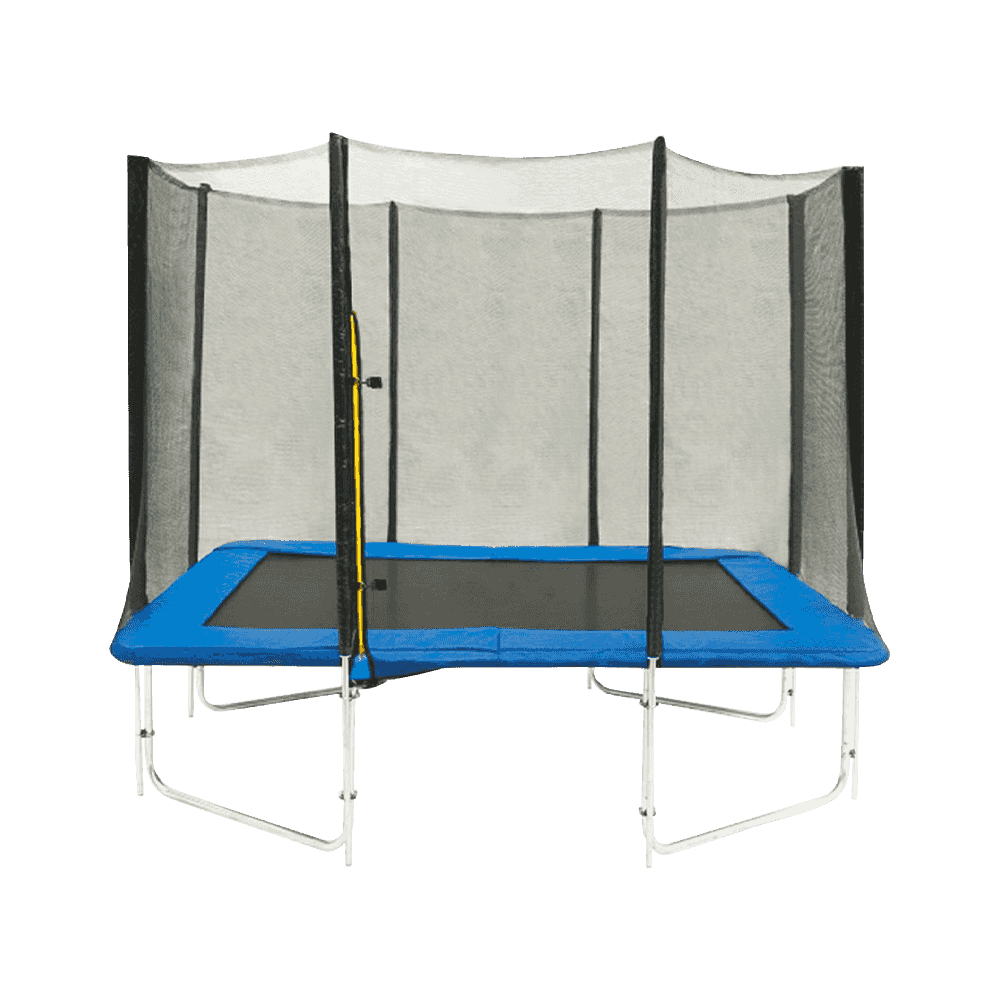 10ft x 8ft Rectangular Trampoline with T-Shaped FrameA rectangular frame offering a larger jumping area and stronger bounce than round models. The T-shaped fixing structure resists twisting, pairing well with the surrounding discussion of spring durability and certification standards.View Product →
A galvanized frame is only as durable as the parts attached to it. Springs corrode before frames do in practice, because spring steel is harder and its protective plating is thinner; a rusted spring loses tension, snaps, and throws uneven forces back into the rails. The mat matters just as much: UV-stabilized polypropylene handles years of sunlight, but the stitching and V-rings at the edges are the true wear points and deserve a check alongside the springs.
Frame pads do double duty. They cover the springs and top rail so jumpers never land on metal, and they shield the coating from impact damage and standing water. A pad that is too thin, or one that has shrunk after a couple of seasons, quietly removes both protections at once.
Enclosure design loads the frame differently too. Poles clamped to the top rail act as long levers, while designs with straight tubes running all the way to the ground transfer landing forces directly into the soil instead of bending the rail. For a 10 ft or 12 ft round trampoline that sees daily use, that difference shows up over the years as a frame that stays true and quiet.
 10ft/12ft Round Trampoline with Straight Enclosure Tubes to the GroundRound trampoline whose enclosure poles run straight to the ground, transferring landing forces into the soil rather than bending the top rail — a design difference that keeps the frame true and quiet over years of daily use.View Product →
Galvanized steel tolerates neglect far better than painted steel, but a short seasonal routine stretches the coating's life by years:
Anchoring deserves its own emphasis. A windstorm can lift an unanchored 14 ft trampoline clear off the lawn and drop it bent beyond repair — the coating survives, but the frame does not. A strap-and-anchor kit costs a fraction of a replacement frame and takes minutes to install.
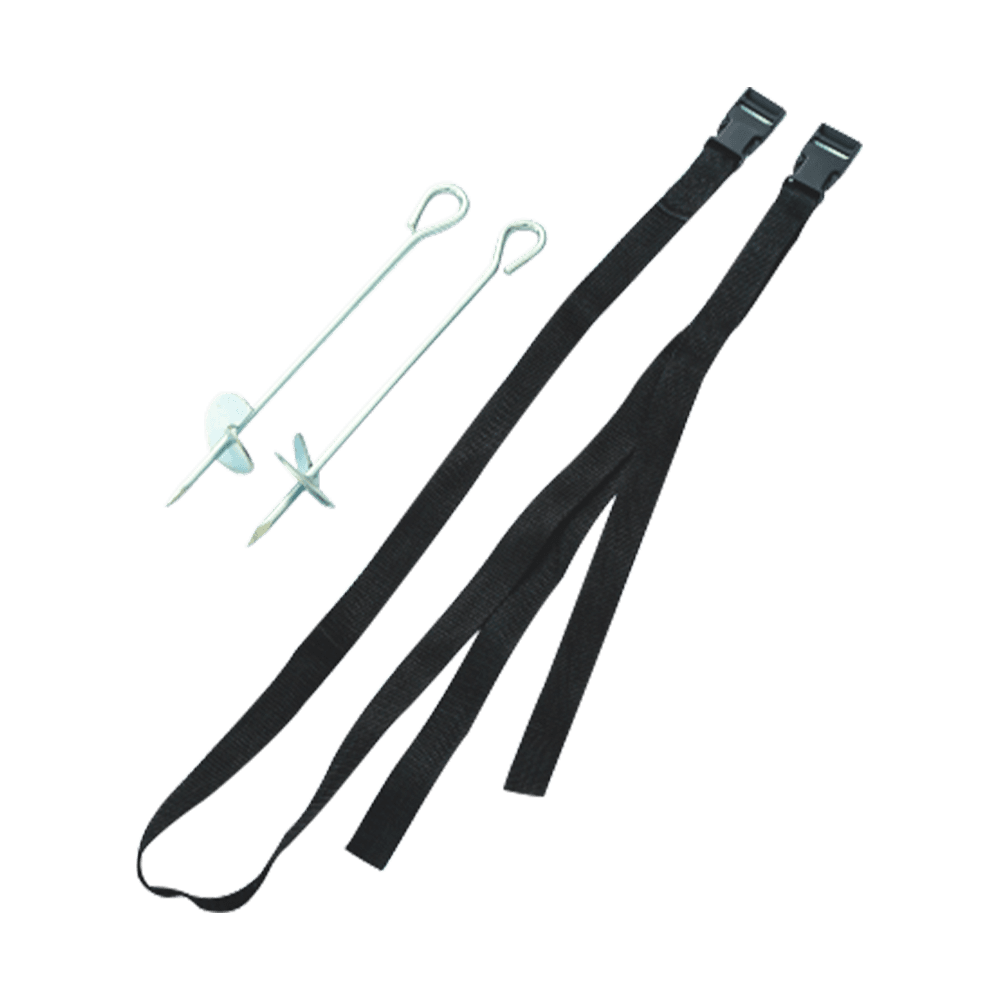 Trampoline Anchor Kit with Straps and Attachment HardwareA strap-and-anchor kit with two spiral steel spikes and high-strength straps that secures the trampoline against wind. The surrounding text stresses how storms can lift and bend unanchored frames, making this a low-cost safeguard.View Product →
Spring care runs on a similar logic of small, regular attention. Tension checks, paired replacement and hook inspection keep the bounce even and protect the rails from uneven loading; our spring maintenance routine for round trampolines walks through the process step by step.
Families choosing one trampoline and buyers ordering a container of them are really asking the same questions at different volumes. Before committing, confirm the galvanizing method used on each tube set, the wall thickness of the top rail and legs on the specific model, whether welds and cut ends are re-treated after fabrication, and which standard the finished assembly was tested against — EN13219, GS, EN71 and REACH cover the bases for outdoor models sold in most export markets. Salt-spray test hours are a useful extra data point when comparing two suppliers side by side.
Frame quality is ultimately a production question. As a factory producing 100,000 to 200,000 trampolines and accessory sets each year for overseas supermarket and retail customers, we treat corrosion-protected frames, UV-stable polypropylene mats and tested enclosures as the baseline rather than an upgrade. Whether the requirement is a 6 ft round frame for a starter backyard or a multi-sized rectangle model for gymnastic training, the galvanized steel underneath decides how long everything above it keeps performing.
If you have any questions, please fill out the contact form at the bottom of the page and contact us.

Anhui Qidi Fitness Equipment Co., Ltd.
Tel: 0086-563-4676999
Fax: 0086-563-4676999
Mobile:086-15158243539
Email: [email protected]
Address: Dongpo Industrial Area, Zhongxi Town, Ningguo City, Anhui Province China
You are welcome to contact us at any time, we value your feedback and suggestions.