
 English
 Deutsch
 русский
Industry News
Home / Blogs / Industry News / Multi Sized Rectangle Trampolines: How to Choose Between 8ft and 10ft Models
Content
Ask anyone who has spent time on both shapes, and they will tell you the same thing: a rectangular trampoline lifts you the same way no matter where you land on the mat. That is why gymnastics programs train on rectangles, and it is also why the shape has moved steadily from gyms into family backyards. For most buyers, the real decision is not whether to go rectangular but which size to order. Multi sized rectangle trampolines, meaning the same core design offered in 8ft and 10ft versions, let you match the trampoline to your yard, your jumpers, and your budget without changing the underlying engineering. The short version: pick 10ft if teenagers or skill training are in the picture, and 8ft if space or younger children set the limits. The rest of this guide explains why, and what to check before you order.
When a manufacturer lists one rectangular model in more than one size, you are usually looking at a single engineered platform built in two footprints. Our rectangle line works exactly this way:
10ft/8ft multi sized rectangular trampoline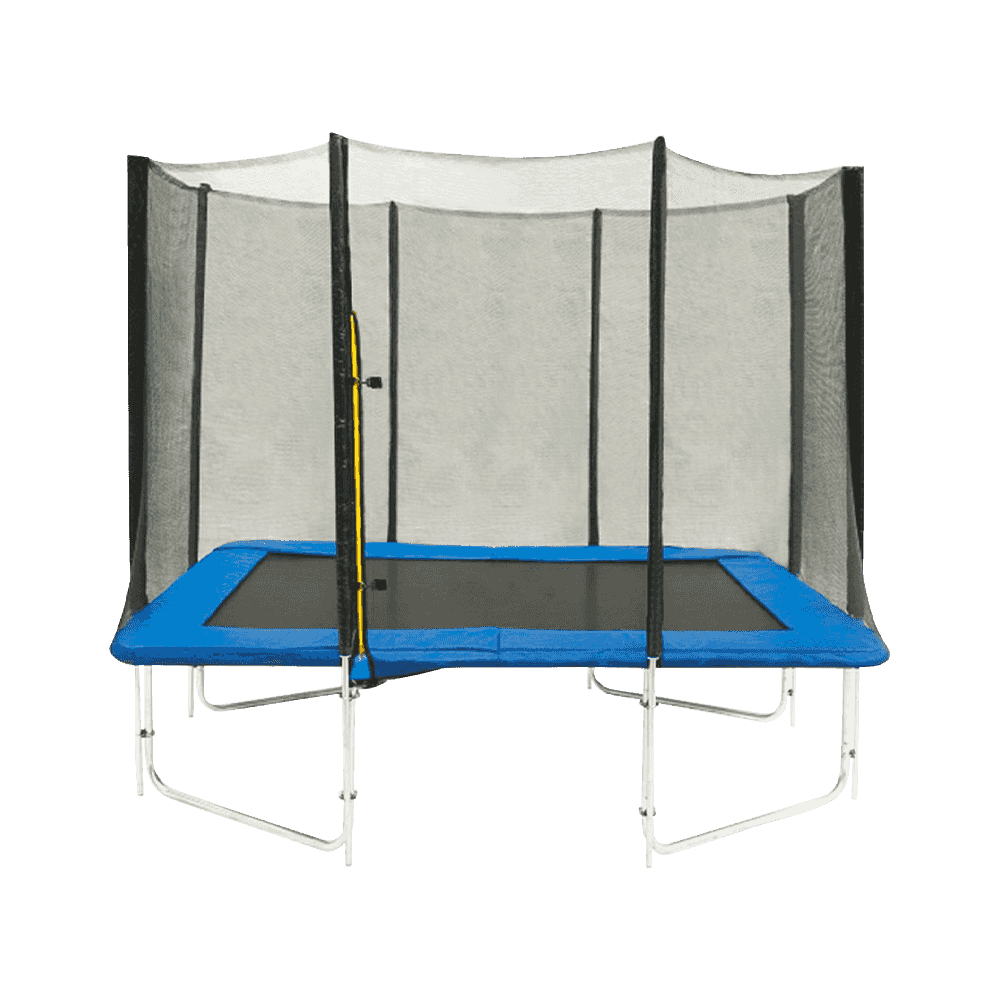 10ft x 8ft Multi-Sized Rectangular TrampolineThis rectangular trampoline uses a galvanized steel frame with a T-shaped structure and a UV-resistant polypropylene jump mat. Both sizes share components, so families can choose by fit and operators can maintain one spare-parts plan.View Product →
Both sizes share the same galvanized steel frame concept, the same UV-resistant polypropylene jump mat, and the same enclosure approach. What changes between the two boxes is the length of the frame rails, the spring count, and the mat dimensions. That consistency matters more than it first appears. Replacement mats, safety nets, and frame pads stay predictable across sizes, assembly steps do not change from one order to the next, and the bounce character you evaluate in one size carries over to the other. For families, this means the buying decision comes down to fit rather than quality trade-offs. For retailers, schools, and camp operators, it simplifies inventory into one product story, two sizes, and one spare-parts plan.
Conclusion first: if bounce quality and skill progression are priorities, the rectangle wins; if the trampoline is mainly for young children playing in short bursts, a round frame is more forgiving. The physics behind this is simple. On a round trampoline, the springs work together to pull every bounce back toward the center, which is safer for unsupervised beginners but limits where you can jump. On a rectangle, springs along each side respond independently, so the mat delivers an even, higher, and more predictable lift across nearly its full surface. Gymnasts and cheerleaders train on rectangles for exactly this reason: the takeoff point does not decide the quality of the jump.
The trade-offs show up in the frame and the price. Corner joints on a rectangular frame carry more stress than any single point on a round ring, so steel gauge and corner reinforcement deserve a close look before you buy. We break the shape comparison down further, factor by factor, in our guide to how rectangle and round trampolines differ in bounce.
| Factor | Rectangular | Round |
|---|---|---|
| Bounce feel | Even lift across the mat; higher, more controlled jump | Softer bounce that drifts jumpers back to the center |
| Usable surface | Nearly the whole mat supports quality jumps | Best rebound limited to the center sweet spot |
| Best suited for | Gymnastics, cheer, older kids, athletic training | Young children and casual mixed-age play |
| Yard fit | Aligns with fences, patios, and narrower yards | Needs a wide, open circular area |
| Frame demands | Reinforced corners and heavier steel sections | Load spreads evenly around the ring |
Size should be decided by three things: who jumps now, who will jump in three years, and what your yard can actually clear. An 8ft rectangular trampoline suits elementary-age children and compact spaces. A 10ft model gives teenagers, adults, and anyone practicing tumbling skills the longer surface those movements need. Whichever size you choose, the one-jumper-at-a-time rule still applies, and the stated maximum user weight for your chosen size should be checked against the heaviest regular jumper, since it is usually rated higher on the larger frame.
Before ordering, measure more than the trampoline itself. Plan for a clear zone of roughly 2 m (6.5 ft) on all sides, free of fences, walls, trees, and hard surfaces, plus open overhead space with no branches or cables. The ground should be level; a frame that sits unevenly will twist over time and wear its joints early.
| Consideration | 8ft rectangular | 10ft rectangular |
|---|---|---|
| Best suited for | Young children and lighter, casual jumpers | Teens, adults, and skill-based training |
| Jump surface | Shorter mat that keeps bounce manageable for beginners | Longer mat with room for routines and higher lift |
| Yard footprint | Easiest to place in smaller or narrow yards | Needs the largest clear rectangle of open ground |
| Long-term fit | Can be outgrown as children get bigger | More headroom for growing jumpers and new skills |
Frame steel, mat fabric, and spring layout determine lifespan far more than price does. Four checks separate a trampoline that lasts for years from one that fades after a single summer:
It is also worth knowing that not every rectangle relies on springs alone. Some designs add fiberglass rod structures to stiffen the frame and stabilize the mat, a construction choice that has proven especially effective at keeping rectangular frames true through changing seasons and heavy use.
A rectangular trampoline directs bounce energy forward along its length, so jumpers travel toward one end rather than drifting to the middle. That makes the enclosure net, padding, and anchoring even more important than on a round frame. The net should stand tall enough for the highest expected bounce, attach securely to both the poles and the mat edge, and be easy to replace when it eventually wears, which is where a replacement trampoline net for all sizes earns its place. Thick pads must cover every spring and rail, because the corners sit close to the jumping surface on a rectangle.
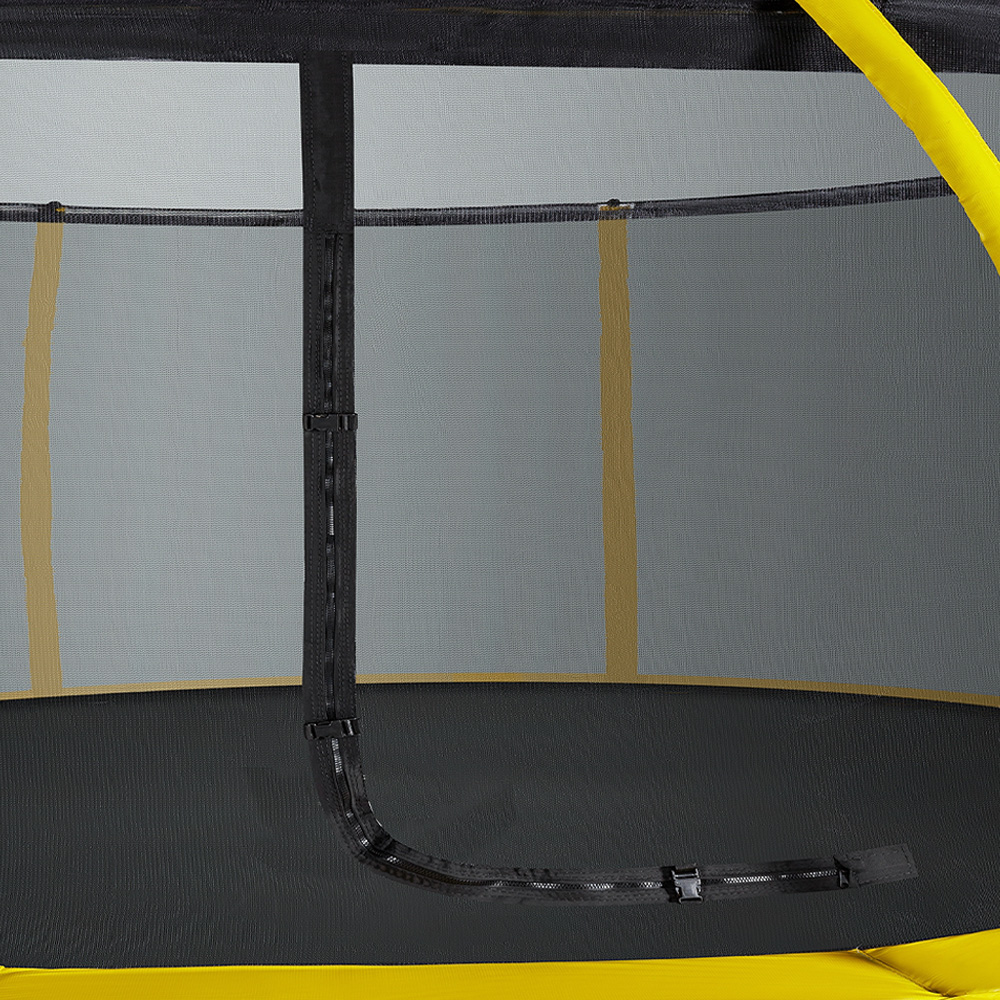 Universal Replacement Trampoline Safety NetMade of high-strength polyester fiber with reinforced drawstrings and buckles, this net fits round or square trampolines of many sizes. Rectangular frames direct jumpers toward the ends, making a securely attached, replaceable net especially important.View Product →
Anchoring deserves special attention as well. Rectangular frames present more surface to the wind and receive more directional force from jumping, so a trampoline anchor kit with straps and attachment hardware should be part of the original setup rather than an afterthought. Pair the kit with spiral anchor stakes on exposed lawns, and re-tension the straps after storms.
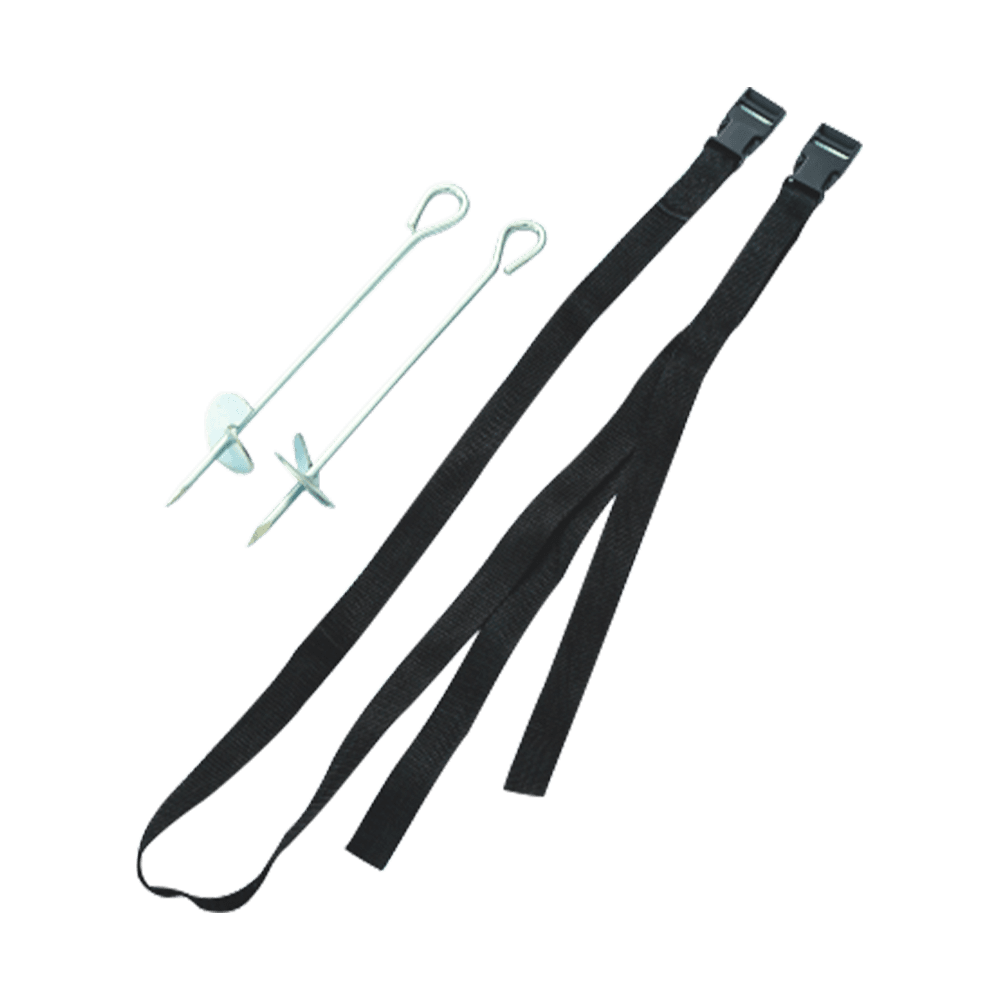 Trampoline Anchor Kit with Spiral Spikes and StrapsThis kit includes two spiral steel spikes and two high-strength straps to keep trampolines from shifting or tipping in wind. Rectangular frames catch more wind and directional force, so anchoring should be part of the original setup.View Product →
Buyers ordering in volume, including supermarkets, distributors, and sports programs, should add a factory-level checklist to the size and construction questions above. Confirm which certifications the product carries, such as GS, EN71, EN13219, EC type approval, and REACH compliance, since these determine what can legally be shelved in many markets. Ask how the two sizes share components, because common mats, nets, and pads reduce spare-parts inventory. Check production capacity against your order calendar; a factory producing 100,000 to 200,000 units a year can absorb seasonal peaks that smaller workshops cannot. Finally, confirm what support looks like after delivery: assembly guidance, replacement-parts availability, and response time on claims.
The manufacturer behind this guide, Tus-Trampolines, publishes its certification list and factory details for exactly this kind of review, and both rectangle sizes ship with the same enclosure and padding specification described above.
The decision comes down to fit and foresight. Choose the 10ft rectangle if your jumpers are past the elementary years or anyone in the household is working on real skills; the extra surface will still feel right three years from now. Choose 8ft when yard space or jumper age sets the boundary, and accept that it may be outgrown sooner. Whichever size you order, insist on a galvanized frame, a UV-stable polypropylene mat, a full-height enclosure, thick frame pads, and a proper anchoring plan. Those five things decide whether the trampoline stays a daily-use asset or becomes a seasonal headache, and none of them depend on the length of the frame rails.
If you have any questions, please fill out the contact form at the bottom of the page and contact us.

Anhui Qidi Fitness Equipment Co., Ltd.
Tel: 0086-563-4676999
Fax: 0086-563-4676999
Mobile:086-15158243539
Email: [email protected]
Address: Dongpo Industrial Area, Zhongxi Town, Ningguo City, Anhui Province China
You are welcome to contact us at any time, we value your feedback and suggestions.