

 English
 Deutsch
 русский
Industry News
Mini Trampolines: Complete Buying & Exercise Guide
Content
- 1 What Makes Mini Trampolines an Effective Exercise Tool
- 2 Key Health Benefits Backed by Research
- 3 Types of Mini Trampolines and Their Specifications
- 4 Essential Features to Consider Before Purchasing
- 5 Effective Exercises for Different Fitness Goals
- 6 Safety Guidelines and Injury Prevention
- 7 Maintenance and Longevity Tips
- 8 Choosing the Right Size for Your Space
- 9 Maximizing Results with Structured Programs
What Makes Mini Trampolines an Effective Exercise Tool
Mini trampolines, also known as rebounders, deliver up to 68% more efficient cardiovascular workouts compared to jogging while significantly reducing impact on joints. A NASA study found that rebounding is 68% more oxygen-efficient than treadmill running, making these compact fitness devices ideal for home workouts, rehabilitation, and low-impact cardio training.
These devices typically measure 36-48 inches in diameter and stand 8-12 inches off the ground. The bouncing motion engages multiple muscle groups simultaneously while the elastic surface absorbs up to 87% of impact stress that would otherwise affect ankles, knees, and hips during traditional exercises.
Studies from the American Council on Exercise demonstrate that just 10 minutes of rebounding can produce similar cardiovascular benefits to 30 minutes of walking, while simultaneously improving balance, coordination, and lymphatic drainage throughout the body.
Key Health Benefits Backed by Research
Cardiovascular and Metabolic Improvements
Regular mini trampoline workouts provide measurable cardiovascular benefits. Research published in the Journal of Sports Science & Medicine shows that 20 minutes of rebounding burns approximately 160-210 calories for a 150-pound individual, with heart rates reaching 60-80% of maximum capacity during moderate-intensity sessions.
The vertical acceleration and deceleration forces during bouncing create a unique metabolic demand. Users experience improved oxygen circulation, enhanced cellular respiration, and increased metabolic rates that persist for up to 2 hours post-exercise.
Lymphatic System Activation
Unlike the cardiovascular system, the lymphatic system lacks a pump and relies on body movement for circulation. The up-and-down motion of rebounding creates gravitational changes that stimulate lymphatic flow by up to 15 times normal rate, according to lymphology research. This enhanced circulation supports immune function and helps remove cellular waste more efficiently.
Bone Density and Balance Enhancement
The gentle impact forces during rebounding provide sufficient mechanical stress to stimulate bone formation without causing injury. Studies on postmenopausal women show that 12 weeks of regular trampoline exercise increased bone mineral density by 2.3% in the lumbar spine and hip regions. The unstable surface also challenges proprioception, improving balance by up to 35% in older adults after 8-week training programs.
Types of Mini Trampolines and Their Specifications
| Type | Spring System | Weight Capacity | Best For | Price Range |
|---|---|---|---|---|
| Spring-Based | Steel coil springs | 220-300 lbs | Budget-conscious users | $40-$100 |
| Bungee Cord | Elastic bungees | 250-350 lbs | Joint-sensitive users | $150-$400 |
| Resistance Band | Heavy-duty bands | 300-450 lbs | Professional training | $300-$600 |
| Folding Models | Varies | 200-300 lbs | Limited storage space | $60-$200 |
Spring-based models offer the most bounce and are economical but can be noisy and create more joint impact. Bungee cord systems provide quieter operation and softer landings, making them preferable for apartment dwellers and those with joint concerns. Resistance band trampolines offer the most durable construction and smoothest bounce, though at premium prices.
Essential Features to Consider Before Purchasing
Frame Construction and Stability
The frame material directly impacts durability and safety. Look for 14-gauge steel or thicker for residential use, with reinforced welding at stress points. Frames should have 6-8 support legs with rubber-tipped feet to prevent floor damage and reduce noise transmission. Quality models feature powder-coated finishes that resist rust and scratching.
Jumping Mat Material and Tension
Professional-grade mats use polypropylene mesh with UV-resistant coating that maintains elasticity through thousands of bounces. The mat should attach with at least 30-40 connection points for even weight distribution. Premium options feature Permatron or similar materials that provide consistent bounce for 3-5 years of regular use.
Safety Handlebar Options
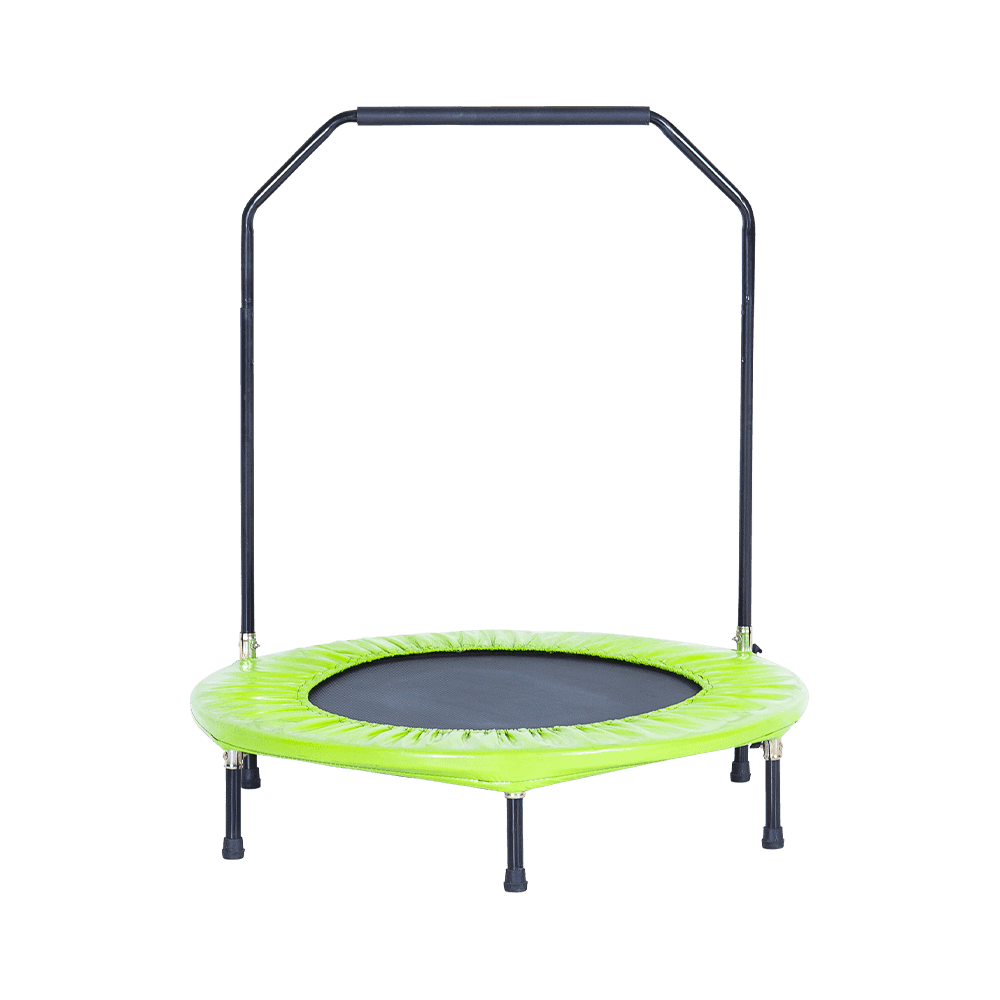
Adjustable stability bars should offer 3-5 height settings ranging from 38-48 inches to accommodate different user heights and exercise types. T-bar designs provide 360-degree support, while single-post models save space. Ensure the handlebar attaches with secure screws rather than friction-fit systems, and features foam or rubber grips for comfort during extended workouts.
Effective Exercises for Different Fitness Goals
Beginner-Friendly Routines
Start with basic bouncing exercises to build confidence and stability:
- Health Bounce: Gentle bouncing where feet barely leave the mat, performed for 2-3 minutes to warm up lymphatic system
- Basic Jog: Light jogging in place with controlled movements, maintaining 120-140 steps per minute for cardiovascular benefits
- Seated Bounce: Sitting on the mat edge while bouncing gently, ideal for those with balance concerns or recovering from injury
- Side-to-Side Shifts: Weight transfer exercises that improve lateral stability without jumping
Intermediate Cardio Workouts
Progress to higher-intensity movements once comfortable with basic techniques:
- High Knees: Alternating knee lifts to chest height, performing 30-second intervals at 140-160 steps per minute
- Jumping Jacks: Full-body coordination exercise that elevates heart rate to 70-80% maximum
- Twist Jumps: Rotating torso while bouncing, engaging core muscles and improving spinal mobility
- Ski Jumps: Lateral jumping motion that targets inner and outer thighs while boosting agility
Advanced Strength and Conditioning
Challenge experienced users with complex movement patterns:
- Squat Jumps: Explosive power training that develops leg strength while maintaining cardiovascular intensity
- Mountain Climbers: High-intensity core exercise performed with hands on mat surface, engaging stabilizer muscles
- Single-Leg Balance Bounces: Proprioceptive training that dramatically improves ankle and knee stability
- Tuck Jumps: Plyometric exercise bringing both knees to chest, building explosive power and core strength
Safety Guidelines and Injury Prevention
Proper Form and Technique
Maintaining correct posture prevents approximately 90% of rebounding-related injuries. Keep your core engaged, shoulders back, and eyes focused forward rather than down at the mat. Land with knees slightly bent to absorb impact, and position your body weight centered over the mat. Avoid bouncing too high—effective workouts occur with 6-8 inch maximum lift off the surface.
Clearance and Environment Setup
Maintain at least 2 feet of clearance on all sides and ensure ceiling height allows for comfortable movement with arms raised overhead. Place the trampoline on level surfaces away from furniture, walls, and sharp objects. Use a protective mat underneath to prevent floor scratching and reduce noise transmission by up to 60%.
When to Avoid or Modify Use
Consult healthcare providers before rebounding if you have:
- Recent surgeries or acute injuries, particularly to joints or spine
- Severe osteoporosis or bone density issues requiring medical management
- Uncontrolled cardiovascular conditions or recent cardiac events
- Pregnancy beyond the first trimester without physician clearance
- Balance disorders, vertigo, or conditions affecting equilibrium
Maintenance and Longevity Tips
Regular Inspection Schedule
Examine your mini trampoline weekly for signs of wear. Check spring or bungee attachments for loosening, inspect the mat for tears or excessive stretching, and verify frame stability. Replace springs or bungees every 1-2 years depending on usage frequency, as worn suspension systems reduce effectiveness and increase injury risk.
Cleaning and Storage
Wipe the mat surface with mild soap and water monthly to remove sweat, dirt, and bacteria. Avoid harsh chemicals that degrade polypropylene fibers. For spring models, lubricate connections annually with silicone spray to reduce noise and prevent rust. If storing long-term, keep in a dry environment away from direct sunlight, which can weaken mat materials by up to 40% over 6-12 months of continuous exposure.
Common Issues and Solutions
Squeaking noises typically indicate dry springs requiring lubrication or loose connection points needing tightening. Uneven bounce suggests worn or broken springs that need replacement. If the mat develops a saggy center, it may be overstretched and require replacement after 300-500 hours of use. Wobbling frames often result from uneven flooring or loose leg connections that should be addressed immediately for safety.
Choosing the Right Size for Your Space
Mini trampolines come in standard sizes that balance exercise effectiveness with space efficiency:
- 36-inch diameter: Compact option requiring minimum 8x8 feet space, suitable for basic bouncing and light cardio in small apartments
- 40-inch diameter: Most popular size offering balanced performance and portability, needs approximately 9x9 feet for comfortable use
- 48-inch diameter: Provides maximum surface area for advanced exercises and taller users, requires 10x10 feet minimum clearance
Taller individuals (over 6 feet) benefit from larger diameters that allow wider stances and more movement variety. Folding models reduce storage footprint by 50-70% but may sacrifice some stability compared to fixed-frame designs.
Maximizing Results with Structured Programs
Sample Weekly Training Plan
A balanced program alternates between cardio-focused sessions and strength-building workouts:
- Monday: 20-minute interval training alternating 1-minute high-intensity bouncing with 1-minute recovery
- Wednesday: 25-minute steady-state cardio maintaining 60-70% maximum heart rate
- Friday: 15-minute strength circuit combining squat jumps, lunges, and core exercises
- Sunday: 30-minute low-impact lymphatic drainage session with gentle bouncing
Progression Strategies
Track improvements by gradually increasing workout duration, intensity, or complexity. Beginners should start with 10-minute sessions 3 times weekly, adding 2-3 minutes each week until reaching 20-30 minute workouts. Intermediate users can introduce handheld weights (1-3 pounds) or resistance bands to amplify muscle engagement. Advanced practitioners might incorporate unstable surface training by performing exercises with one foot on the mat and one on the floor.
Combining with Other Exercise Modalities
Mini trampolines complement various training approaches. Use rebounding as active recovery between strength training days, reducing muscle soreness by up to 30% through enhanced blood flow. Pair with yoga or stretching for comprehensive flexibility work. Athletes report improved performance when incorporating 2-3 rebounding sessions weekly alongside sport-specific training, particularly for activities requiring explosive power or coordination.
 Previous
Product Consultation
Search
Categories
Recent Posts
If you have any questions, please fill out the contact form at the bottom of the page and contact us.
Related products

Anhui Qidi Fitness Equipment Co., Ltd.
Quick Links
Contact Details
Tel: 0086-563-4676999
Fax: 0086-563-4676999
Mobile:086-15158243539
Email: [email protected]
Address: Dongpo Industrial Area, Zhongxi Town, Ningguo City, Anhui Province China
Come and Contact Us
You are welcome to contact us at any time, we value your feedback and suggestions.
