

 English
 Deutsch
 русский
Industry News
Polygon Trampolines: Why the 8ft Polygonal Shape Outperforms Round
Content
Most parents shopping for a backyard trampoline default to round — it's familiar, widely available, and easy to find. But if your yard is tight and your kids want more control over where they land, a polygon trampoline with multi-sided frame design solves problems that a round unit simply can't. Here's what actually matters when you're deciding.
Why the Shape Changes Everything
A round trampoline has one unavoidable physics issue: the center concentrates bounce energy. Jumpers naturally drift toward the middle, and with two kids on at once, an off-center landing can send someone flying sideways. The polygonal frame distributes tension more evenly across its flat sides, so the bounce surface behaves more consistently no matter where you land.
This also means 8ft polygonal trampolines with enclosure nets require less clearance on each side than an equivalent round model, making them better suited to narrow yards or patios with obstacles nearby. The octagonal frame footprint is more compact in proportion to the actual usable jumping area.
What the Specs Actually Tell You
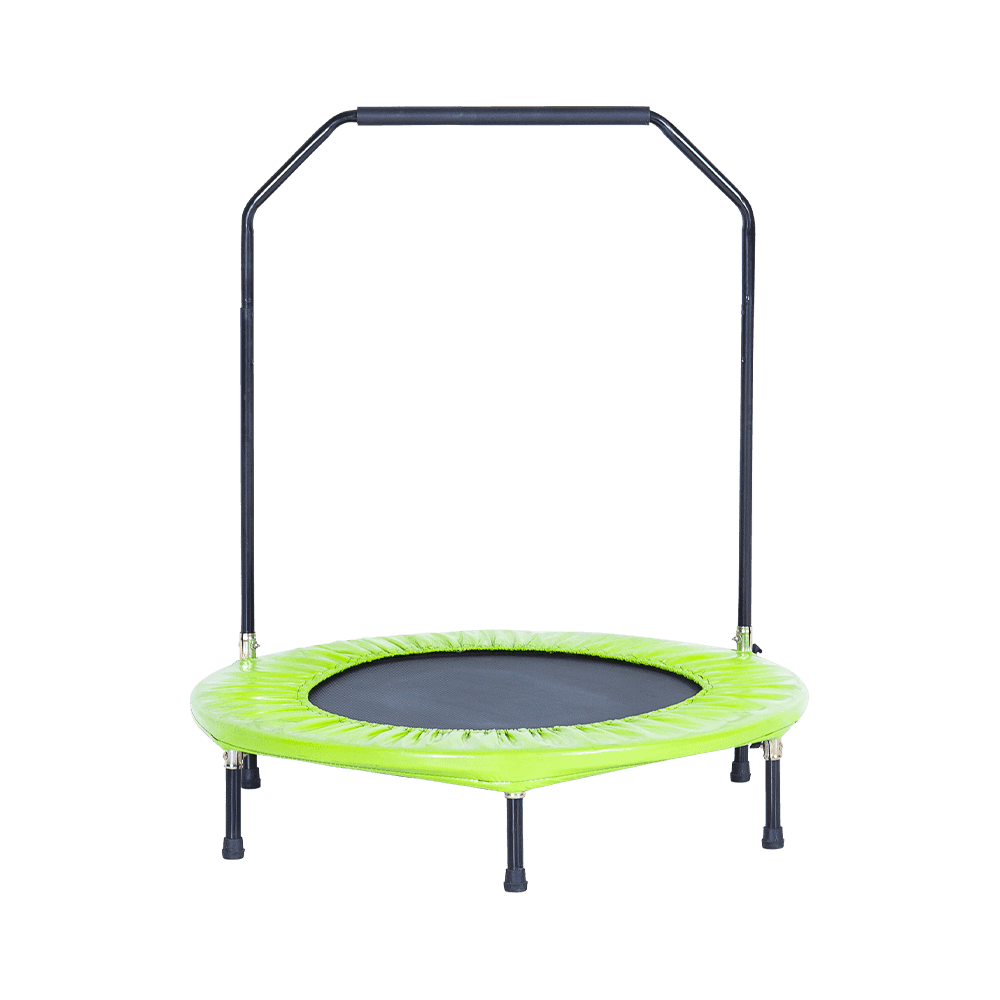
Qidi's 8ft polygonal model uses a steel pipe, nylon mesh, and spring construction with a hot-galvanized "W"-leg frame — the kind of double galvanization (inside and outside) that resists corrosion over multiple winters. The enclosure poles stand between 1.5 m and 2.5 m tall, which is tall enough to catch an adult or teenager mid-bounce, not just a small child.
| Spec | Detail |
|---|---|
| Size | 8 ft (octagonal) |
| Frame Material | Hot-galvanized steel pipe (inside & outside), "W" legs |
| Jumping Surface | Nylon mesh + steel spring |
| Enclosure Height | 1.5 – 2.5 m |
| Net Material | High-strength tightly woven polyethylene |
| Pad Protection | EPE foam (width 20–32 cm, thickness 10–24 mm), PVC-coated for UV resistance |
| Certifications | CE, ROHS, GS, EN71, REACH, EN13219 |
| Recommended Age | 3+ years |
The foam spring padding is 10–24 mm thick EPE foam wrapped in UV-resistant PVC — meaning it won't crack or fade after a season outdoors. The enclosure net itself uses tightly woven polyethylene that's soft enough to prevent finger injuries on contact, which is a detail many budget models skip.
Certifications: What CE, EN71, and EN13219 Actually Mean
These certifications aren't marketing decoration — they carry specific requirements. EN13219 is the European standard for trampolines that sets minimum requirements for frame strength, spring load, and enclosure integrity. EN71 covers toy safety, including material restrictions (relevant for the net and pad materials kids will touch). CE and ROHS compliance confirm the product meets EU safety and chemical-use regulations.
For buyers in North America, look for whether the model also carries GS certification — a German mark that applies more rigorous third-party testing than self-declared standards. Qidi's polygon line holds all of the above, which matters if you're purchasing wholesale or reselling into regulated markets.
8ft vs. Larger Sizes: Who Is It Really For?
An 8ft trampoline is the right call for children aged 3–12 jumping one at a time, or families with limited outdoor space. If your primary users are teenagers or adults, or you want multiple simultaneous jumpers, a 10ft or 12ft round unit will give more room to move. The 8ft polygon shines when footprint matters more than maximum airtime.
If you need something larger with a different frame style, the round trampoline range in various sizes from 6ft to 16ft covers bigger families. For users who want something that doubles as athletic training equipment, rectangle trampolines built for gymnastics-style training offer a different bounce profile entirely — consistent across the full surface, better for practicing specific skills.
Installation and Long-Term Maintenance
Assembly requires two people and roughly 60–90 minutes. The "W" leg design self-stabilizes on most flat surfaces, but on soft ground or in windy regions, anchor stakes are strongly recommended. A trampoline anchor kit drilled into the ground prevents tipping during storms — a non-negotiable in areas with seasonal high winds.
For maintenance, inspect the spring pad after winter storage. UV-degraded foam padding loses its shock absorption even when it looks intact; replace it before the first heavy-use season. The enclosure net should be checked for small tears at the seam points, as this is where polyethylene wears first. Both components are available as replacements without needing to replace the full unit — a cost consideration worth factoring into your purchase decision.
For a full seasonal maintenance routine and safety setup checklist, the outdoor trampoline safety and setup guide covers every step from ground preparation to post-season storage.
The Honest Tradeoff
Polygon trampolines with octagonal frames are less common than round models, which means fewer third-party accessory options and a slightly higher initial cost per unit. What you get in return is a more controlled bounce, a frame that handles multi-directional force better, and a shape that fits awkward yard spaces more efficiently. For families buying a trampoline to last 5–10 years, the structural advantage of polygonal design holds up — and the certification stack (CE, GS, EN71, EN13219, REACH) gives legitimate assurance that the materials and engineering meet tested standards, not just claimed ones.
 Previous
Product Consultation
Search
Categories
Recent Posts
If you have any questions, please fill out the contact form at the bottom of the page and contact us.
Related products

Anhui Qidi Fitness Equipment Co., Ltd.
Quick Links
Contact Details
Tel: 0086-563-4676999
Fax: 0086-563-4676999
Mobile:086-15158243539
Email: [email protected]
Address: Dongpo Industrial Area, Zhongxi Town, Ningguo City, Anhui Province China
Come and Contact Us
You are welcome to contact us at any time, we value your feedback and suggestions.
